Level transmitters are devices used to measure the level of a liquid or solid within a container, tank, or other vessel and transmit this information to a monitoring system. They play a crucial role in various industries, including water treatment, oil and gas, chemical processing, food and beverage, and pharmaceuticals.
Types of Level Transmitters:
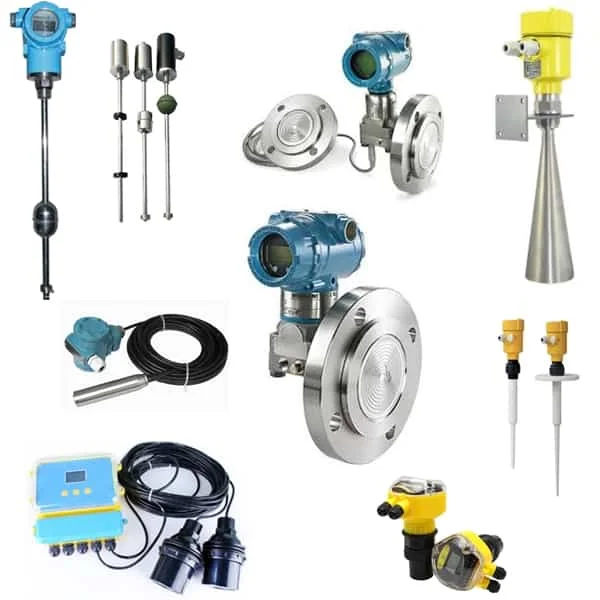
- Float Level Transmitters: Use a floating object to measure the level of the liquid. The float rises and falls with the liquid level, and this movement is translated into a level measurement.
- Ultrasonic Level Transmitters: Use ultrasonic waves to measure the distance from the sensor to the surface of the liquid or solid. The time it takes for the waves to return is converted into a level measurement.
- Radar (Microwave) Level Transmitters: Use radar pulses to measure the distance to the surface. They are highly accurate and can be used in harsh environments.
- Capacitance Level Transmitters: Measure the level based on changes in capacitance caused by the presence of the material between two electrodes.
- Hydrostatic Level Transmitters: Measure the pressure exerted by the liquid column above the sensor and convert this pressure into a level measurement.
- Magnetostrictive Level Transmitters: Use a magnetic float that moves along a probe to measure the level. The position of the float is determined by measuring the travel time of a pulse along a wire.
- Conductive Level Transmitters: Use electrical conductivity to measure the level of conductive liquids. The presence of the liquid completes an electrical circuit and provides a level measurement.
- Vibrating (Tuning Fork) Level Transmitters: Use a vibrating probe that changes frequency when covered by a liquid or solid material. The change in frequency indicates the presence of the material.
Selection Criteria:
- Measurement Range: The operational range should match the expected level variations.
- Accuracy: The precision required for the application.
- Material Compatibility: The sensor material should be compatible with the measured substance.
- Environmental Conditions: Consider the temperature, pressure, and potential corrosive nature of the environment.
- Output Signal: Type of electrical signal output (e.g., 4-20 mA, HART, Modbus).
- Installation Requirements: The physical constraints and mounting options for the transmitter.
Contact EML for Level Transmitters


 Manufacturing
 Facilities Maintenance
 Power & Utilities
 Mining & Metals
 Oil & Gas